How to Upload Firmware Into Q2n Camera
E'er since the pandemic hitting, I've been researching various devices to observe affordable gear recommendations for music teachers and students.
Recently, I've been hearing good things virtually the new Zoom Q2N 4K. I've used a bunch of Zoom products over the years and have always been impressed with the build quality and usability.
With a wide angle lens, born high quality microphones, and the ability to function both as a standalone video camera and a webcam, the Q2N seems like a steal at around $220.
I was a lilliputian cautious near this a new offering, though. I purchased the Zoom Q8 Handy Video Recorder in early on 2019, and I felt like I got a little burned by that device. Despite having a ton of great features and good build quality, the video quality on the Q8 was pretty crude.
At $399, the Q8 is nearly twice the price of the Q2N 4K. I was skeptical as to how much, if any, of an improvement there was in the quality of the video footage from the Q2N 4K.
Initial impressions and features
This photographic camera is and so… beautiful! I knew that information technology was going to exist minor, but I was still surprised by its tiny size. Coming in at 3 1/2 inches tall and three inches broad, it's about half the height of my iPhone.
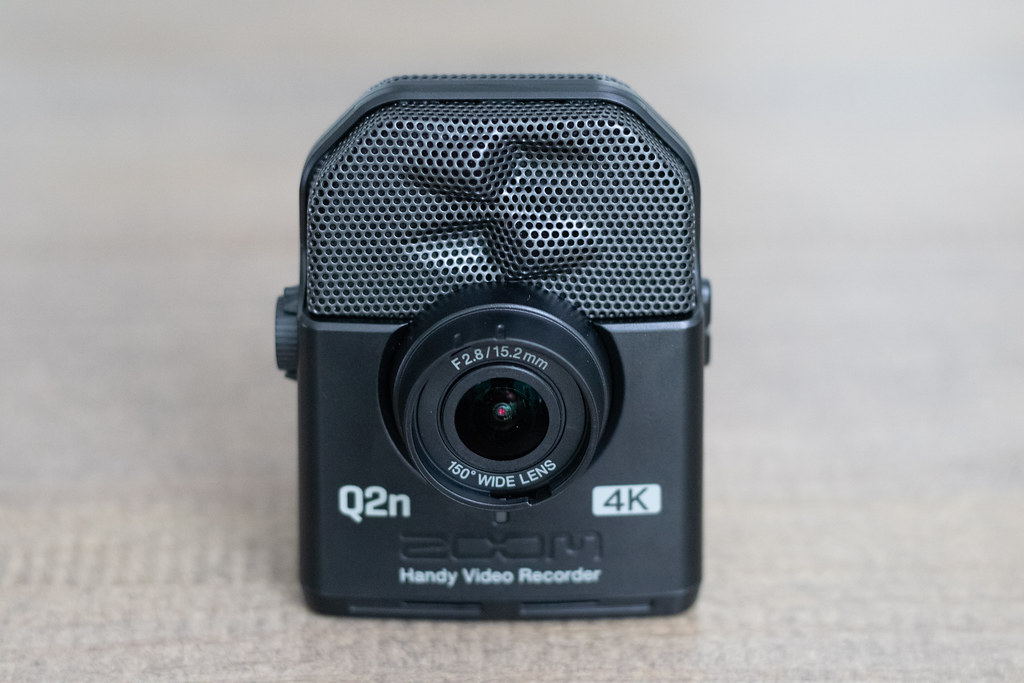
There'due south an 1/viii inch headphone jack and an i/viii inch external input on the side, forth with a volume slider for the headphones. I've always appreciated the ability to monitor the recording level o my other Zoom devices via headphones, and I appreciate that this is included even in this very small device.

On the other side, there's a volume knob for decision-making the microphone level plus ports for micro USDB and mini HDMI. I've been connecting via the micro USB port to my laptop, and I've noticed some lag when using Zoom Conferencing for video calls. I'thou not sure whether that was a one-time glitch or if it has to practice with slower speed on the micro USB, simply I'll examination this with a mini HDMI cable and volition update this with the results.

On the forepart of the H2N 4K, there's the 150 degree wide angle lens, and at F two.eight / xv.2 mm, it has performed quite well for me in lower light settings. This is a huge weakness of the Zoom Q8, and that alone makes the Q2N well worth the buy price.
You've also got a lens cap that y'all can attach to the trunk of the device via a string, and a lens hood that is quite helpful when filming outdoors or around bright lights.
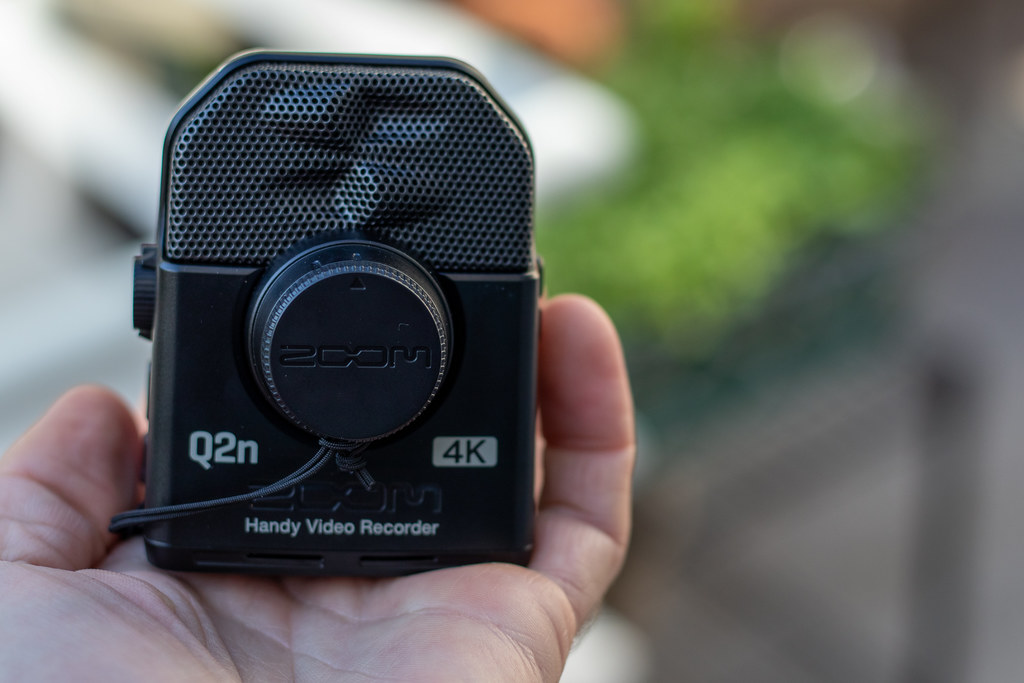
On the back, you've got controls that, similar every Zoom product, are easy to navigate and pretty intuitive one y'all get a handle on the workflow.

On the bottom row, at that place's a power/play button, a tape push button, and an exit/settings push button. Yous'll know if you're recording or not by looking at the front of the device. If the light'south greenish, you're not recording. If it'south red, you are.
Simple, correct? It'due south hilarious how many times I thought I was recording when I was filming the video for this review, though. Not a design trouble, simply me not understanding the divergence between green and red, I guess.
There are likewise physical buttons for selecting:
- video quality: 4K-thirty, 4K-24, 1080-60, 1080-xxx, 1080-24, 720-30, and audio only
- Field of view: 5 settings, from 150 degree broad angle to telephoto (digital zoom)
- Scene: machine, outdoor, sunset, night, concert light, jazz club, dance club, monochrome, sepia, pic, ten-process, flat
- Lo cut
- Audio: 44.ane K, 48K, 96K
- Auto gain (leave this off if y'all want to have your true sound reflected)
The camera records to micro SD, and there'southward no menu included with the device (in that location wasn't with mine, at least). This makes total sense given the small course cistron, though it did send me scrambling to order a new card when I realized that I could simply fit a few minutes of footage on my sometime 4GB Nintendo Switch carte. Getting a 128 GB micro SD bumped my 4K filming time up to over three hours.
Screen quality versus quality of footage
While everything works well on the Q2N 4K, the entire device fells a fiddling lower budget than the Q8 or the H6 audio recorder, my other two Zoom devices. At one 1/ii inch by 1 inch, the screen is truly tiny, and the image I'm seeing on the screen looks pretty depression resolution.
Fright non, however. Once y'all transfer that footage to your computer, information technology'll wait great, particularly when shot in 4K.
Unlike the Q8, this is not a touch screen device. That helps keep the cost and complexity of the device down, but it makes filming yourself as little more challenging.
Testing it out
My hope was that this device would be a peachy "Swiss Ground forces Knife" solution for teachers, performers, and students. With a built-in set of stereo microphones and 4K resolution, this photographic camera seemed to take dandy potential to cheque all the boxes.
After all, musicians need a USB mic, a good webcam, and the ability to get high-quality footage of themselves. Would the H2N 4K be up to the task?
Results as a video photographic camera
I tested the Zoom Q2N 4K for both vlog footage and for recording my bass, comparing the results with the Zoom Q8 and the Canon EOS M50, which is my main camera these days for video and photography.
Here are screenshots from my footage (the reason for my bizarre facial expressions!), and you lot tin watch the complete video on YouTube and click the time stamps in the clarification to bound to the diverse comparisons:


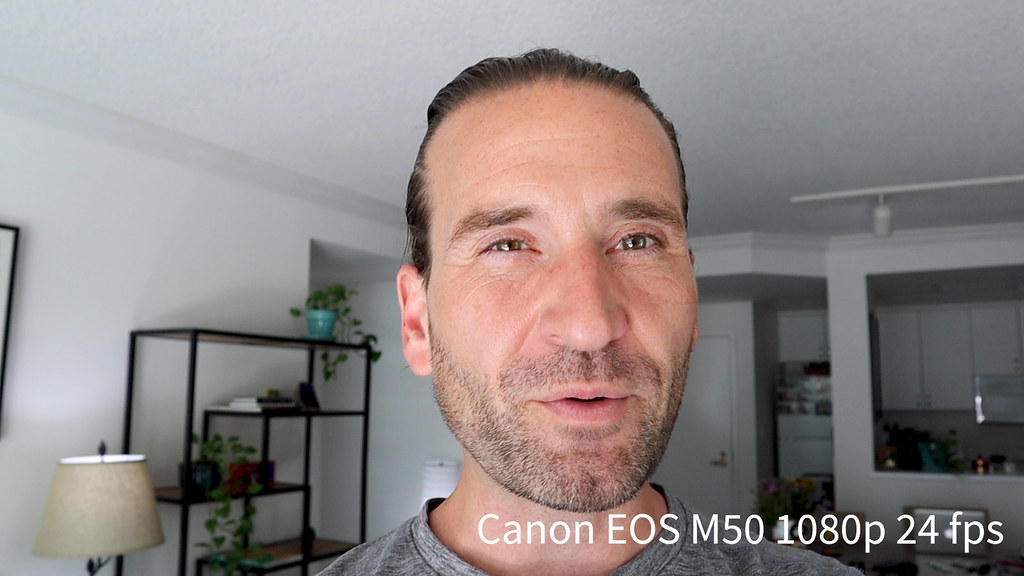
The results weren't surprising, though I was quite impressed at how well the Q2N 4K held up in lower light situations. The Canon M50 produced the all-time results, followed past the Q2N 4K, with the Q8 coming in a afar third visually.
Taking information technology farther with the Canon EOS M50
In addition to using the 15-45mm kit lens with the Catechism M50, I shot some footage with the EOS 11-22mm lens (cracking for wide-angle YouTube content) and the "slap-up 50" portrait lens with the Catechism mount adapter:
Hither I am about ii feet from the photographic camera lens, with the 15-45mm and 11-22 both at their shortest focal lengths:


I dearest the footage I get off the 50mm portrait lens (despite my pained expression!) . On the Canon EOS M50, this lens becomes more like an 80mm lens, so I had to move information technology almost eight feet away from me to become the post-obit shot:

Audio comparison
In terms of audio, I've got to paw it to the Q8, followed closely past the Q2N and so the Canon M50. The Rode Videomic Pro helps a lot with audio for the Catechism, merely I notwithstanding prefer the tone of the Q2N 4K and the Q8.
Still, I was pleasantly surprised at how well that Canon fared in terms of sound, even with the built-in microphone. That born M50 mic won't be winning whatsoever awards for sound fidelity, but it's not horrible either, and the visuals really kick it up a notch in terms of overall features.
Also yous tin can check out the YouTube video to hear the results for yourself.
Webcam mode comparison
This is where both the Q8 and the Q2N 4K smoothen. Setting them upwards is dead simple, though I did need to download a firmware update for the Q8 in order to utilise both the camera and microphone at the same fourth dimension. All you do is plug in the Q2N or Q8, plough information technology on, select "webcam", and you're off to the races.
Catechism recently released new webcam utility software, probable as a result of then many more people jumping into videoconferencing.Currently, notwithstanding, it'southward only available for Windows, and then as a Mac user I'm stuck until they roll out a Mac version.
There are a few other means, both with software and hardware, to make a DSLR or mirrorless camera function as a webcam, only they just aren't as simple equally the plug & play Zoom video cameras.
Here's a look at the results from my MacBook Pro internal camera, the Q2N 4K, and the Q8, with a little iPhone footage thrown in for good mensurate:


Lag on the Q2N 4K
The Q2N 4K footage certainly looks better, both for video conferencing and when playing my instrument. Unfortunately, like I said before, I was getting quite a bit of lag when using the Q2N as a webcam.
I'chiliad curious if that's because I was connecting via micro USB. The Q8 connects with mini USB to the computer, and I've never had lag issues with it, just I was getting noticeable lag on micro USB with the Q2N.
There'southward too the option to plug in using mini HDMI. I don't take 1 of those cables at abode at the moment, but I just ordered one, then I'll be testing and reporting dorsum.
Audio quality for videoconferencing
The Q2N 4K and Q8 blow the socks off of the MacBook or iPhone internal speakers. Personally, I think that the Q8 gets the best overall sound, only the Q2N 4K is however quite practiced, and it's a huge comeback over the born mics.
Weaknesses of the Q2N 4K
Overall, I'm a fan of the Q2N 4K, though in that location are a few problems worth considering as you weigh purchasing 1:
1 – No ability to take pictures
This is a large advantage to spending the bucks for a DSLR or mirrorless camera. After all, musicians are storytellers, and while having the ability to capture our duration all art in audio and video grade is crucial, it sure is prissy to be able to shoot a few high-quality images as well.
Really, though… you lot've almost certainly got a smartphone that takes good photos, then unless you're trying to motion into the professional photography world, you lot've probably got enough horsepower with your current devices already to become adept imagery.
2 – No flip-out screen
I totally become why the Q2N doesn't have a flip-out screen, simply it'southward a bit of a bummer to always exist wondering what angle yous're capturing. I found myself getting ready with my bass, and then going around to the Q2N to take a wait at where I think I'chiliad standing and hazard a guess.
I concluded upwardly filming a whole bunch of "am i in the shot?" 10 second videos every time I wanted to film a new bending. While not a huge deal, especially since the broad angle lens means that y'all're probable to be in the shot if the lens is pointed anywhere nearly you, information technology'due south simply another thing that tin can interrupt your workflow, and it'due south an area where the Canon M50 or Q8 have an advantage.
three – No image stabilization
This is only going to exist an event if you're planning on using this to shoot a lot of vlog-style YouTube videos where you're moving effectually. If that's the case, definitely look into a photographic camera with prototype stabilization.
For near people, though, this is not going to be a bargain-billow. This camera was intended to exist planted on a tripod and accept in a musical performance, and it excels at that.
4 – Consumes bombardment life chop-chop
Maybe it'due south but me, but I felt like i was constantly replacing the AA batteries on this device. I've never noticed this on the audio devices from Zoom. I'g guessing that it takes more ability to shoot 4K video than to tape audio.
When using information technology as a webcam, you have the choice to describe power from the computer, so there are no worries about draining the batteries. If you're planing on running around with the photographic camera quite a bit, be sure to stock upwards on AA batteries since at that place's no Air-conditioning adapter option on this device.
5 – Split files and confusing file numbering system
This is more of a technical thing, but for both he Q2N and Q8, Zoom splits files longer than 25 minutes into multiple files. This is done to prevent possible corruption of large files, and you can string them dorsum together without intermission in your video editing software.
This "assembling the puzzle" process tin become confusing in a hurry, nevertheless. The fashion that Zoom names the files causes the first chunk of the file to appear after the subsequent chunks, and if you've shot a lot of footage with the same camera bending, y'all can find yourself violent your pilus out in a hurry.
The plus side is that, unlike the Canon M50 you can record until you run out of memory bill of fare space or batteries. The Canon will but make one file every time you printing record, but there'southward a hard limit of 30 minutes per video file.
This is not a big deal if you lot're shouting YouTube videos or single movements of pieces, but it's a major bummer if you're filming interviews or doing anything long-form where you only want to set the camera and forget it.
Caput to head: Q2N / Q8 / Canon M50
Here's how I'd sum upwardly my experiences and recommendations:
Zoom Q2N 4K – $219
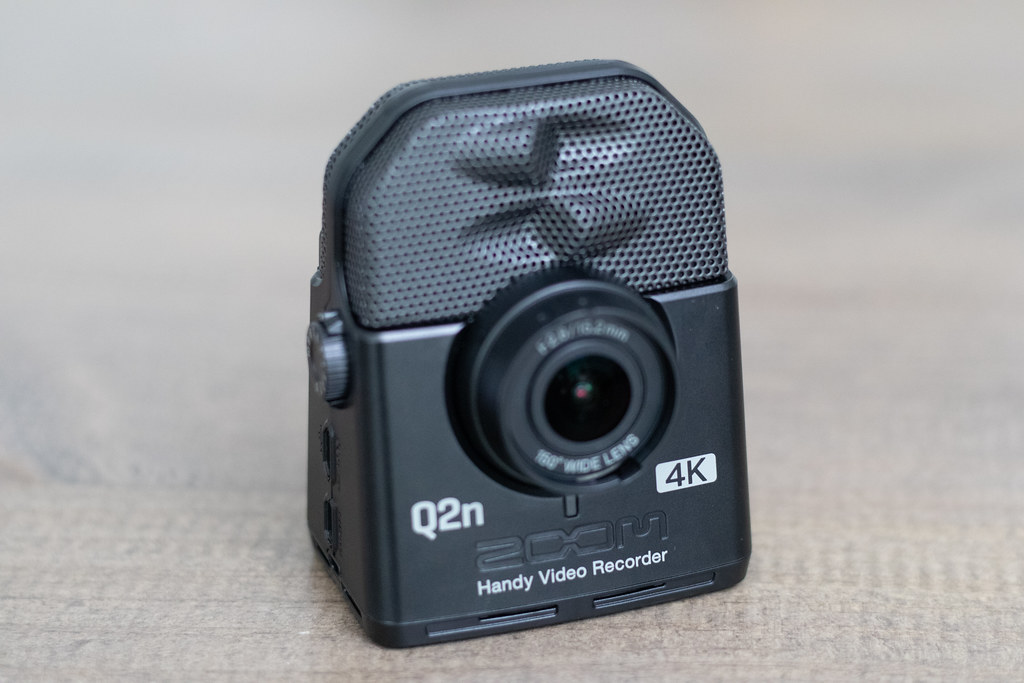
Pros:
- price – this is a steal, especially considering how many features you get
- size – it'south and then easy to have this with you at all times
- excellent video quality
- Extremely easy to use
- functions as video camera, webcam, and USB mic
- tin can plug into computer to save battery
- high-quality built-in microphones
Cons:
- Records to micro SD (ok, not really a con, just just make sure you have a large capacity micro SD carte)
- no flip-out screen
- lower (though still skilful) build quality
- potential lag when using every bit web cam (though this might have been a Fluke on my terminate or attributable to the micro USB)
- eats through the bombardment life
- no paradigm stabilization
- potentially confusing file formats
Zoom Q8 – $399

Pros:
- functions as video camera, webcam, and USB mic
- rechargeable bombardment
- tin can plug into computer or external power to salvage bombardment
- flip-out screen with touch functionality
- high-quality built-in microphones
- power to swap out mic capsule and also add together two external XLR mic inputs
- great for podcasts and customizable for alive recording situations
Cons:
- By far the everyman quality video results
- no image stabilization
- potentially confusing file formats
- file format is cranky with Premiere Pro (this drives me crazy—I have to convert everything before importing, and I can't notice a amend solution—aargh!!)
Canon EOS M50 – $499

Pros:
- Past far the highest quality video
- very customizable, though you'll end up spending considerably more money once you throw in lenses, microphones, etc.
- tin can have photos
- rechargeable battery
- flip-out bear upon screen
- easy to use "beginner mode" for menus
- external mic input
- cold shoe mount on device for attaching an external mic
Cons:
- Low-quality born microphone, non really built for music
- more than "fiddly" – not as "plug & play" every bit the Zoom cameras
- no USB mic functionality
- tougher (though technically possible) to utilise as a webcam
- bigger
- more expensive
- bombardment life non awesome
Final thoughts
In my stance, the Zoom Q2N 4K is a rock-solid multipurpose device for practically any musician.
While I certainly don't meet it replacing my Canon, I'm already finding a ton of uses for it as a second camera for videos and even for shooting a quick video when I don't feel like dragging out a agglomeration of actress gear.
While the Q8 has more features and is more customizable, the superior video quality of the Q2N 4K makes it difficult to justify spending the extra $180 for the Q8 unless you lot're looking for a very specific use case.
My verdict? If you are a musician in need of a webcam or are looking for an easy-to-utilise multipurpose device, the Q2N 4K is an piece of cake choice.
Bass News Correct To Your Inbox!
Subscribe to get our weekly newsletter covering the double bass world.
Success! Now check your email to confirm your subscription.
tuttlewhichisatur.blogspot.com
Source: https://doublebassblog.org/2020/05/zoom-q2n-4k-worth-it-for-musicians.html
0 Response to "How to Upload Firmware Into Q2n Camera"
Post a Comment